Our sustainability goals
Where we are today
In 2021 we conducted a baseline audit to establish our current carbon footprint. This has estimated our total emissions at 5,992t CO2e, for the reference year 2018-2019 (as the most recent full year view pre COVID). A breakdown is shown below.
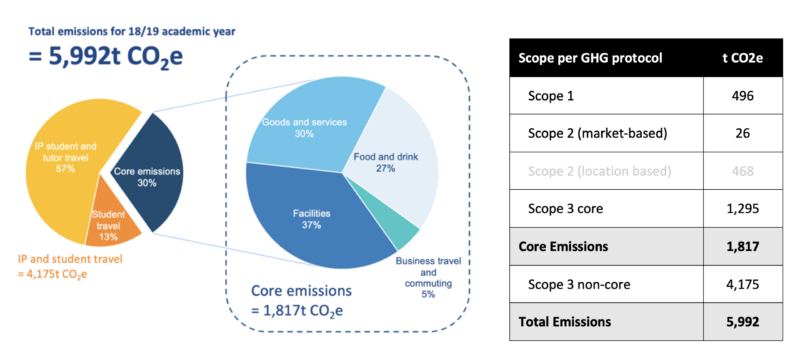
The Greenhouse Gas Protocol classifies emissions into three scopes: Scope 1 (direct emissions), Scope 2 (indirect emissions – purchased energy), and Scope 3 (all other indirect emissions – not energy-related).
The College Sustainability Manager, Ellen MacDonald, has worked with fellow sustainability leads to build a colleges carbon emissions toolkit to help colleges to calculate their emissions moving forward. This will mean colleges are able to calculate their emissions in a uniform way for the same period. The tool was created for the 2024-2025 academic year, aligning with University reporting, using the relative DEFRA carbon emissions conversion factors.
The tool currently calculates Scope 1, 2 and elements of Scope 3 including water, waste, T&D losses, and WTT as this is information readily available to colleges. Categories for Scope 3 will be added to the tool in the future. Please look out for an update regarding 2024/25 emissions later in the 2025/26 academic year.
By 2030, we aim to achieve four goals:
- A net zero position for scope 1 and 2 emissions
- A 50% reduction of core emissions across scopes 1 to 3
- A meaningful reduction in non-core / reportable scope 3 emissions
- Implementation of offset arrangements for the remainder.
These are founded on the general principles that:
- Our focus will be removal and reduction as the clear priority, ahead of offset.
- Our offsetting approach will be based upon the Oxford Principles for Net Zero Aligned Carbon Offsetting.
- We will adopt and align with standard measurement methodologies and tools developed by the Collegiate University, to aid a common approach to ongoing monitoring and target setting.
- We expect our understanding to continually develop, technology to improve, and challenges to arise. We will thus keep our targets under review, and be prepared to adapt them as needed.
We have set ourselves six priorities:
Priority One: Replacement of fossil fuel heating
This is the single largest component of our scope 1 and 2 emissions, accounting for over 99% of our scope 1, and around 9% of overall core emissions. We recognise that replacement of current gas-based solutions will be challenging on a practical level, and also from a cost perspective. Up-front capital costs are likely to be significant, and alternative energy sources currently attract a higher price. Swapping over to electricity without paying attention to the broader need to reduce overall energy demands should also be avoided. Until we are able to develop a clear plan in this area, our target will necessarily remain under review, and subject to later confirmation.
Priority Two: Switch to 100% renewable power
We already draw the majority of our energy in this category from renewable sources – saving around 440 tCO2e of emissions – but could remove the remainder.
Priority Three: Making a shift in food and drink consumption
Catering accounts for 27% of our core emissions, of which meat and dairy represent 77%.
Our immediate efforts will be focused upon:
- Increasing take-up of meat alternatives by improving the range and appeal of those, and by affording them the most prominent positions on selection menus and across servery layouts (i.e. ahead of meat options).
- Where selections are required, defaulting to non-meat options as the standard – i.e switching around our current default settings.
- Reducing the amount of meat in standard portions
- Reducing food waste through improved forecasting and planning
Options involving removing meat / dairy provision (e.g. meat-free days) were considered, but not included. There were two primary reasons for this. First, our preferred approach is to encourage and support amended behaviours, and forcing these through removing choice would run counter to those aims. Secondly, approaches that make special occasions of not doing something can simply act to reinforce the notion that those things represent the norm, which is the precisely the view we should be aiming to alter.
Priority Four: Informed approach to procuring goods and services
This is a challenging area for reductions, as in many cases there are few low / no emissions supply options for goods and services that are critical to our day to day operations.
Our policy will be to minimise emissions through:
- Selecting providers with strong sustainability credentials, where available
- Choosing low carbon product and service alternatives where we can (maintaining quality)
- Favouring products that can be used multiple times rather than those that have a short usable life
We hope to achieve at least a 20% reduction through the combination of such measures.
Priority Five: Reducing business travel and commuting
- We will adopt an economy-only approach to all travel bookings
- We will make use of virtual meetings in place of travel where possible
Priority Six: Reducing downstream supply impacts
Beyond core emissions are the downstream supply related impacts caused primarily by travel of students and conference guests to college, and in particular those travelling from overseas. These emissions are considerably larger than core, representing around 70% of our total footprint. While not currently reportable under the GHG protocol, we have determined to seek improvements here too.
Achieving reductions in this area presents challenges to our core aims and objectives, as well as a significant portion of our current income. Our approach will thus be founded upon a steady minimisation, avoiding any compromise to our academic activities, and positioning ourselves to be able to mitigate financial impacts.
We shall:
- Encourage lower carbon methods of travel for our students (e.g. public transport), supporting this through practical support for storage over vacations, or finding ways to incentivise such choices.
- Seek to redesign current services to be less carbon-intensive, by adapting the length of our own college-run (i.e. conference-based) courses, to reduce turn-over travel while maintaining volumes.
- Develop alternate, lower carbon-cost, commercial revenue streams to displace carbon-heavy services over time.
Energy Strategy
We have commissioned an energy audit and strategy, designed to help us understand options, costs, and timelines – and make detailed plans under priorities one and two. This will cover:
- Insulation, replacing windows and doors, reducing air leakage, reducing solar gain
- Replacing old lighting with LEDs, provision of mechanical ventilation with heat recovery, energy efficient pumps, fans, heating and cooling systems etc.
- Opportunities to switch from fossil fuel heating and hot water generation to high efficiency heat pumps
- Water reduction by utilising controls and low flow fittings
We have set clear targets for each priority
Specific reduction targets associated with each are set out below.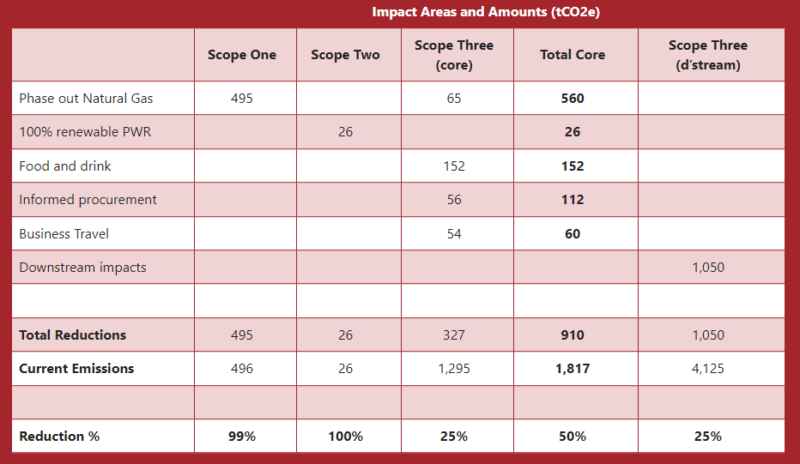
Beyond the initiatives identified above, we will also:
- Continue to engage across the college community to identify, assess, trial and adopt quick wins that help to eliminate or reduce emissions across all scopes
- Work with our Investment Advisory Committee and others to understand our options for targeting and encouraging lower carbon investment profiles
- Ensure all new building projects are designed and implemented with as low a carbon footprint as possible – both for construction and ongoing management purposes